
The Senolytic Shift: Why Fisetin Is Getting So Much Attention
Cellular senescence has become one of the most intriguing areas of healthy-aging research. Now, fisetin—a naturally occurring plant flavonoid—is moving from laboratory studies into human clinical research. Here’s what we know, what we’re still learning, and why Arcwell® is helping advance the science.
Aging is something we usually notice from the outside: changes in energy, strength, recovery, or appearance. But some of the most important changes associated with aging happen much deeper—at the cellular level.
One area attracting growing scientific interest is cellular senescence, a state in which certain stressed or damaged cells stop dividing but remain metabolically active. Cellular senescence is now recognized as an important component of the biological processes associated with aging.1
Scientists are increasingly investigating what happens when these cells accumulate with age—and whether selectively targeting persistent senescent cells could eventually influence aspects of age-related health.2 This emerging field is known as senotherapeutics. And one natural compound attracting particular attention is fisetin.
What Is Fisetin—and Why Are Scientists Studying It?
Fisetin is a naturally occurring flavonoid, a family of plant compounds found in foods including strawberries, apples, persimmons, grapes, onions, and cucumbers. Scientists have studied fisetin for a variety of biological properties, but interest within aging research grew when laboratory studies identified senolytic activity in certain experimental models and cell types.3
Senolytics are compounds being investigated for their potential to selectively promote the removal of certain senescent cells. They belong to a broader category known as senotherapeutics—approaches being studied for their potential effects on cellular senescence.2
A widely cited 2018 study took this research further. Researchers reported that fisetin reduced markers associated with cellular senescence in experimental models. In aged mice, fisetin treatment was also associated with improvements in several age-related measures and increased lifespan.4
The findings helped generate significant interest in Fisetin within the field of healthy-aging research. But there's an important distinction: Promising results in cells and animals don't automatically mean the same effects occur in humans. That's why the next stage of the fisetin story matters so much.

Fisetin Research Is Moving Into Humans
For years, excitement surrounding fisetin centered primarily on laboratory and animal models, but that focus is steadily shifting toward human biology. Researchers are now actively evaluating fisetin through randomized controlled clinical trials, advancing the science from early cellular observations to the pivotal question: how does it actually perform in people?
A 2024 Pilot Study Examined Biological Age
A small human pilot study published in 2024 investigated fisetin supplementation in 10 generally healthy adults over age 50. Participants took 500 mg of fisetin daily for one week each month for six months, while researchers assessed biological age using an epigenetic-age test.5 The results were mixed.
Four participants showed a reduction in measured biological age, five showed an increase, and one showed no change.5 Because the study included only 10 participants and lacked a placebo control, these results cannot establish that fisetin reduces biological age. However, the study is interesting for another reason: it represents an attempt to investigate fisetin directly in generally healthy older adults rather than relying solely on laboratory and animal models.
Randomized Human Research Has Also Tested Fisetin
Fisetin has also progressed into randomized, placebo-controlled human research. One clinical trial investigated an intermittent fisetin regimen in people with knee osteoarthritis.
Participants received approximately 20 mg/kg of fisetin per day for two consecutive days, followed by 28 days without treatment and then another two-day course. The study included 34 participants in the fisetin group and 40 in the placebo group and examined outcomes including pain, physical function, inflammatory and senescence-related biomarkers, muscle strength, and cartilage-related measures.6
The findings across the many measured outcomes were not uniformly favourable to fisetin.6 That's important. It demonstrates why promising biological mechanisms need to be tested rigorously in people rather than assumed to produce clinical benefits. But it also represents an important milestone in the science: Fisetin has moved beyond laboratory research into controlled human investigation.
The evidence is still emerging.
Fisetin has demonstrated senolytic activity in preclinical research, while researchers are now working to understand how—and whether—these findings translate to humans.3-6 Human studies to date have involved different populations, doses, treatment schedules, and outcomes, so more controlled research is needed before conclusions can be drawn about fisetin's senolytic effects in people. What makes this field exciting is how quickly the science is progressing:
Naturally occurring flavonoid → Laboratory research → Senolytic activity in experimental models3 → Encouraging preclinical aging research4 → Early human investigation5 → Randomized controlled human trials6 → Ongoing clinical research
Arcwell® Is Helping Advance Human Fisetin Research
At Arcwell®, we believe emerging healthy-aging science deserves more than exciting headlines. It deserves rigorous human research.
That's why Arcwell® is supporting ongoing human clinical research involving fisetin in collaboration with Sunnybrook Research Institute in Toronto, Canada. The research is helping contribute to the growing human evidence surrounding fisetin and its biological effects.
Because this research is ongoing, we won't speculate about the results before the study is completed and the data are analyzed. But supporting human research reflects something fundamental about Arcwell's approach.
Much of the excitement around fisetin began in laboratory and animal research. The next step is to ask whether—and how—those observations translate to people.
We don't simply want to follow healthy-aging research. We want to help advance it.
Why We Think Fisetin Is Worth Watching
What makes fisetin particularly interesting isn't that the science is finished. It's that the science is progressing.
Early laboratory research identified intriguing biological activity.3 Animal research expanded the investigation into aging and cellular senescence.4 More recently, researchers have begun studying fisetin directly in people—including controlled clinical research.5,6
And Arcwell is proud to participate in that next stage through our support of ongoing human research with Sunnybrook Research Institute.
At Arcwell®, Transparency means distinguishing between:
- What we know.
- What early research suggests.
- And what scientists are still working to discover
Why Quality Matters When Choosing Fisetin
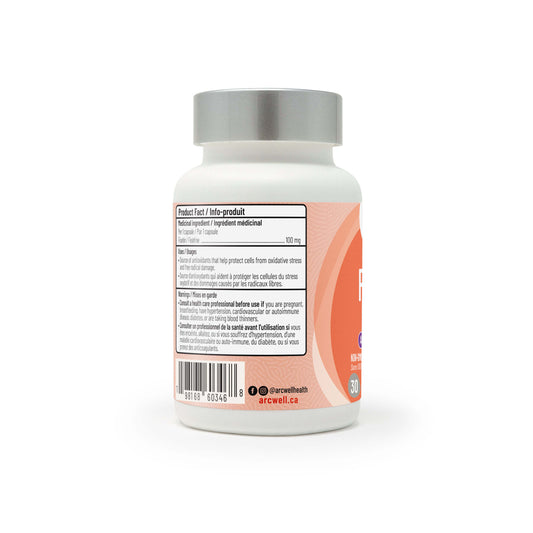
For people who choose to incorporate fisetin into their wellness routine, purity, dosage, and quality matter. Arcwell® Fisetin provides 100 mg of high-purity fisetin per capsule.
Our approach is built around three principles:
- Purity
- Effective Dosage
- Transparency
Arcwell® Fisetin is formulated with >98% high-purity fisetin, is vegan and third-party tested, and is licensed by Health Canada under NPN 80133096.
Interested in incorporating fisetin into your healthy-aging routine? Discover Arcwell Fisetin and learn more about our approach to purity, quality testing, and science-led supplementation.
The Bottom Line
Cellular senescence has become one of the most fascinating areas of modern aging research, and fisetin has emerged as a natural compound worth watching.
The scientific story began largely with laboratory and animal research.3,4 Now fisetin is increasingly being investigated in humans. Early studies have produced preliminary and mixed findings, while controlled clinical research is helping scientists better understand what fisetin may—and may not—do in people.5,6
Arcwell is proud to support that next stage through our ongoing human clinical research collaboration with Sunnybrook Research Institute. We don't believe emerging science needs exaggerated promises to make it exciting. The fact that there is still so much to discover is precisely why the research matters.
References
- López-Otín C, Blasco MA, Partridge L, Serrano M, Kroemer G. The Hallmarks of Aging. Cell. 2013;153(6):1194–1217.
- Kirkland JL, Tchkonia T. Senolytic drugs: from discovery to translation. Journal of Internal Medicine. 2020;288(5):518–536.
- Zhu Y, Doornebal EJ, Pirtskhalava T, et al. New agents that target senescent cells: the flavone, fisetin, and the BCL-XL inhibitors, A1331852 and A1155463. Aging. 2017;9(3):955–963.
- Yousefzadeh MJ, Zhu Y, McGowan SJ, et al. Fisetin is a senotherapeutic that extends health and lifespan. EBioMedicine. 2018;36:18–28.
- Lee E, Burns M. The Effects of Fisetin on Reducing Biological Aging: A Pilot Study. Alternative Therapies in Health and Medicine. 2024;30(9):6–10. PubMed record
- Senolytic Drugs Attenuate Osteoarthritis-Related Articular Cartilage Degeneration: A Clinical Trial. ClinicalTrials.gov Identifier NCT04210986. ClinicalTrials.gov study and results
Human research into fisetin and senotherapeutics remains developing. Preclinical findings should not be interpreted as evidence that fisetin has been proven to eliminate senescent cells, slow biological aging, or extend lifespan in humans. Arcwell's ongoing research collaboration described above has not yet established clinical efficacy.